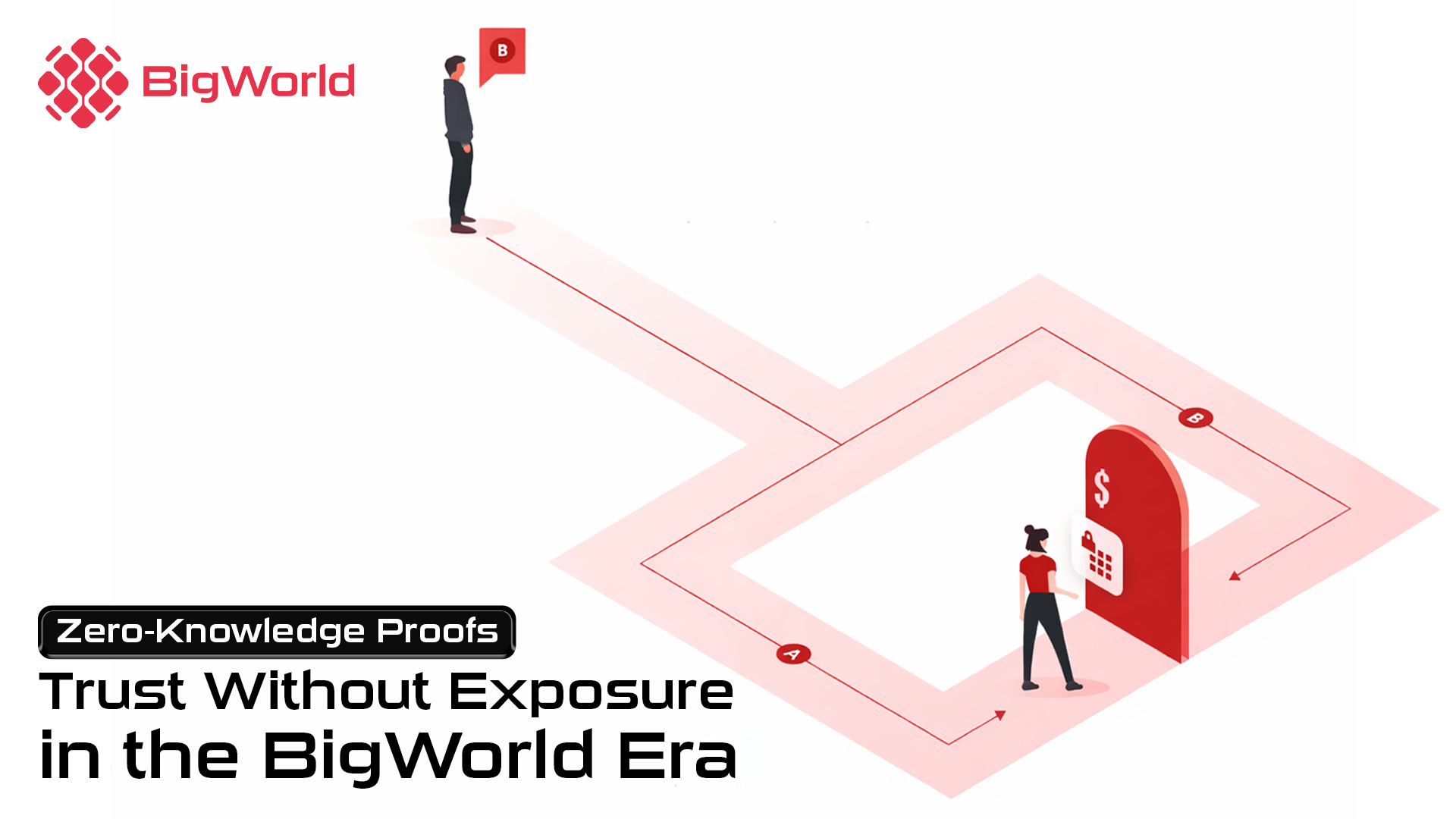
Zero-Knowledge Proofs: Trust Without Exposure in the BigWorld Era
In a digital world powered by data, trust has become both essential and fragile. Every login, transaction, and interaction asks us to reveal something personal. Over time, this constant exposure has led to breaches, surveillance, and systems that know far more than they need to.
Zero-Knowledge Proofs offer a different path forward.
They allow us to prove that something is true without revealing the underlying information itself. Not what you know, just that you know it. In the BigWorld blog will reveal subtle shift changes how trust is built, verified, and scaled.
1. What Zero-Knowledge Proofs Really Mean
A Zero-Knowledge Proof is a cryptographic method that lets one party convince another that a statement is true, without revealing any additional information. The verifier learns nothing beyond the validity of the claim.
Think of proving you know a password without ever sending the password, or proving you meet certain requirements without disclosing your full identity. The interaction confirms correctness, not content.
This idea has existed for decades, but only recently has it become practical at a real-world scale.
2. Why Zero-Knowledge Matters Now
The timing of Zero-Knowledge Proofs is not accidental.
Modern digital systems collect enormous amounts of personal data simply because verification has traditionally required disclosure. This model no longer scales, socially, economically, or ethically.
At the same time, public blockchains introduced radical transparency. While this made systems verifiable, it also exposed users in ways that are unacceptable for everyday use. Zero-Knowledge Proofs resolve this tension by allowing systems to remain open and auditable while keeping user data private.
Most importantly, trust itself is becoming programmable. In a Big World filled with autonomous agents, global platforms, and persistent digital identities, trust cannot rely on institutions alone. It must be mathematically enforceable.
3. How Zero-Knowledge Proofs Work (Without the Math)
At an intuitive level, Zero-Knowledge systems transform a computation into a proof. Instead of sharing inputs or steps, the prover generates a cryptographic artifact that attests the computation was executed correctly.
Modern constructions such as zk-SNARKs and zk-STARKs compress complex logic into proofs that are small, fast to verify, and extremely hard to fake. The verifier doesn’t replay the computation; they verify the proof.
This is what makes Zero-Knowledge powerful: verification becomes lightweight, while privacy remains intact.
4. Where Zero-Knowledge Is Already Changing the World
Zero-Knowledge Proofs are no longer theoretical.
They are being used to create private authentication systems where users can prove eligibility without exposing identity. In blockchain ecosystems, they power rollups that dramatically reduce transaction costs while preserving security. Financial systems are adopting ZK techniques to enable confidentiality without sacrificing auditability.
In large-scale games and virtual worlds, Zero-Knowledge opens new design space. Players can prove ownership, fairness, or compliance with game rules without revealing strategies or private state. This is especially critical as digital worlds become more persistent, interconnected, and economically meaningful.
5. Final Words
Zero-Knowledge technology is still evolving. Tooling is improving, prover performance is accelerating, and abstractions are becoming more developer-friendly. The complexity is real, but so is the momentum.
What was once a niche area of cryptography is quickly becoming core infrastructure.
Zero-Knowledge Proofs make this possible. They replace blind trust with mathematical certainty, and unnecessary exposure with intentional disclosure.
In the future, we won’t ask systems to know everything about us.
We’ll ask them to verify just enough.
.jpg&w=2048&q=75)